In a world run on information, we are surprisingly bad at sharing it.
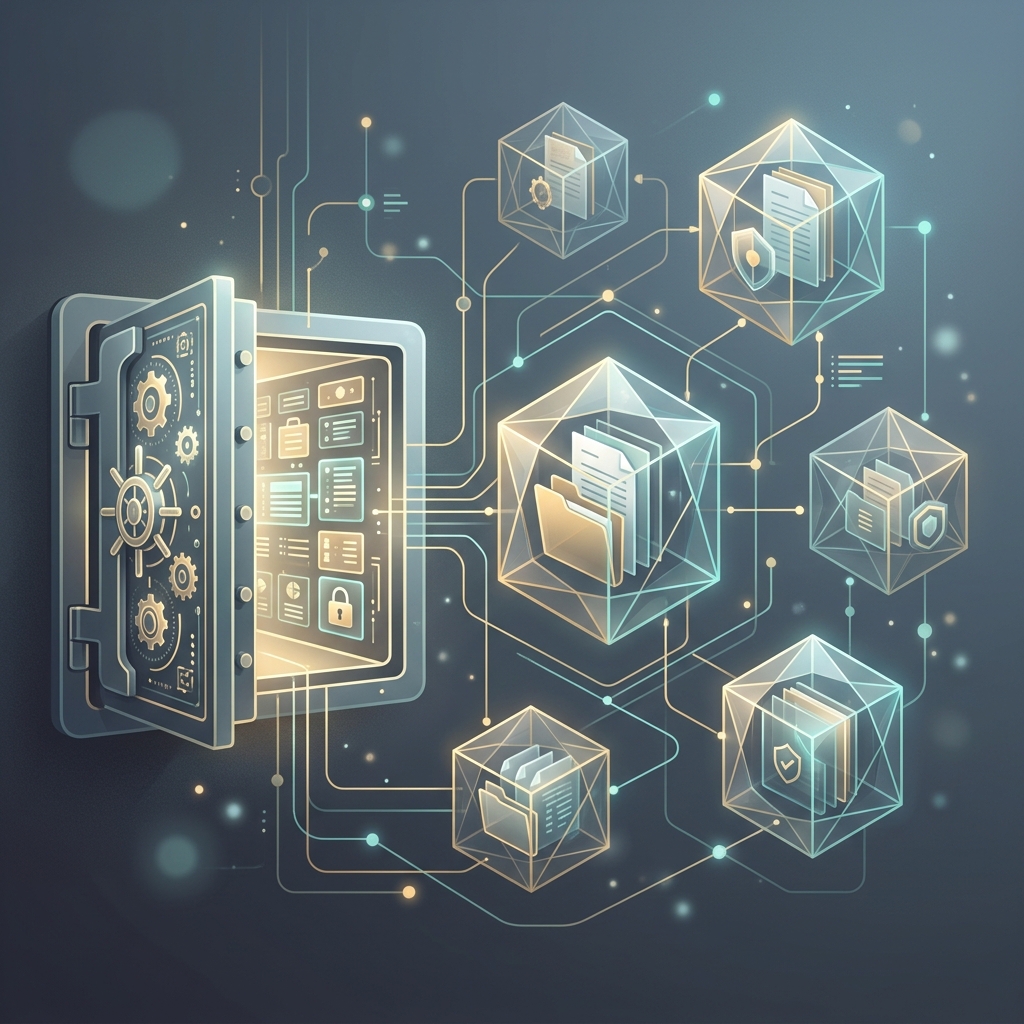
Every day, organizations build higher walls around their data. We lock valuable insights in databases, spreadsheets, and legacy systems because sharing them feels too risky, too expensive, or too complex. When we do try to collaborate, we resort to sending copies of files over email, manually filling out forms, or building fragile, custom connections that break at the first sign of a system update. We have accepted data silos as a natural cost of doing business. But they aren't.
What if we could share verified information instantly, securely, and without rewriting a single line of your existing software? What if we could build a network of trust that bridges different companies, departments, and applications as easily as the internet connects websites?
To solve this challenge, we built Jamii Sovereign OS—a distributed, truth-based operating system designed for small and large organizations alike.
What is a Truth-Based Operating System?
When you think of a traditional operating system (like Windows, macOS, or Linux), its job is to manage physical hardware: your keyboard, your hard drive, your screen, and your memory. It provides a standard environment where programs can run without fighting over resources.
A Truth-Based Operating System does something similar, but at the organizational level. Instead of managing hardware, it manages trust, verified facts, and collaboration.
Jamii Sovereign OS: Conceptual Architecture Stack
Rather than forcing systems to talk directly to one another through thousands of custom, fragile connections, Jamii Sovereign OS acts as a unified digital layer running quietly across your entire organization—and between you and your partners. It defines a standard environment where:
- Facts are certified once and can be instantly proven to anyone, anywhere, without copying the underlying raw data.
- Collaboration rules are democratic, transparent, and built directly into the system, not buried in hundreds of pages of legal contracts or complex code.
- Silos are unlocked safely because owners retain absolute control over who sees their data, for how long, and under what conditions.
It is not just a database or an API framework. It is a new way of running a business in a connected, intelligent world. Let’s take a journey through the layers of this system—from simple, common-sense foundations to a global map of connected intelligence.
The Trust Constellation: A Bird's-Eye View
Before we dive into the layers, let's visualize how the entire system connects. Think of it as a secure digital ecosystem where information flows dynamically but safely under clear rules:
Ecosystem Data Flow Constellation
Layer 1: The Ground Floor — "Almost Everything is a Claim"
To understand our system, we must discard the old way of thinking about data. Traditionally, databases store "records"—static blocks of text in columns and rows.
Instead, our system is built on a simple, beautiful concept: The Claim.
A claim is simply a statement of fact. It’s a digital receipt that says something happened, someone is who they say they are, or a specific condition was met.
Anatomy of a Digital Claim
Immutable, Signed Fact primitiveFact: "Employee John Doe worked at Acme Corp from 2018 to 2022"
Issuer: acme_corp_hr_authority
Status: Verified & Cryptographically Signed
Here are the three golden rules of claims in our system:
- Almost everything is a claim: An employment record, a university degree, a safety certification, a temperature reading from a shipping container—these are all claims.
- Claims can be validated: A claim isn't just self-declared text; it has a verifiable status. It can be checked, approved, and sealed.
- Claims can be based on other claims: This is where the magic happens. A claim can stand on the shoulders of previous claims, creating an unbreakable chain of trust.
Think of a visa stamp in a passport. The stamp is a claim that you are allowed to enter a country. But that claim is based on another claim: your passport itself, which is a claim by your government that you are a citizen. You don't have to carry your birth certificate and school records everywhere; you just present the passport because the chain of trust is already established.
The Business Implication: Zero-Copy Collaboration
In legacy systems, if Company A needs to verify information from Company B, they must copy the data into their own database. Now, you have two versions of the same file. If Company B updates it, Company A's version is immediately outdated.
By treating data as a network of claims, you never need to copy-paste data again. You simply reference the original, verified claim. If the original claim changes or is revoked, the system automatically alerts everyone down the line. It is elegant, secure, and completely eliminates the risk of outdated information.
Layer 2: Capable Authorities — "Who Says So?"
A claim is only as good as the person or system backing it. If I make a claim that "I am a licensed neurosurgeon," you probably shouldn't let me operate on you unless that claim is backed by a recognized medical board.
This brings us to our second layer: Authorities.
In our system, validating a claim requires an authority (or a set of authorities) that everyone in the network agrees is capable of making that validation.
- A university is the authority on who graduated from its classes.
- A government agency is the authority on corporate registries.
- A senior manager is the authority on project sign-offs.
When a claim is created, it specifies which authority is responsible for validating it. The system then ensures that the claim is routed directly to them for approval.
The Business Implication: Absolute Clarity of Trust
No more guessing where a piece of information came from or whether it is genuine. Every single piece of data in the system has a digital signature linking it directly to the agreed-upon expert who verified it. If a supplier claims their materials are "sustainably sourced," the system verifies that the signature on that claim belongs to an approved environmental auditor—instantly and automatically.
Layer 2.5: Distributed Trust — Quorums & Key Distribution
But what if a single authority is compromised or biased? If one manager makes a mistake, does the system of trust fall apart?
To prevent this, Jamii Sovereign OS introduces Quorums and Distributed Key Management.
Instead of a single server or individual holding the master key to your company's records, Jamii Sovereign OS distributes cryptographic "shares" of keys among multiple independent parties.
A Quorum means a group of trusted authorities must agree before a claim can be validated or sensitive data can be unlocked.
- You can write a rule that says: "To approve this high-value vendor contract, we need a quorum of 3 out of 5 board members to sign off."
- Because the keys are distributed, no single person can act alone. It is like a bank safety deposit box that requires both your key and the bank manager’s key to open, but scaled up to protect your entire digital enterprise.
The Quorum Protocol
Claim: "Acme Corp is cleared for $10M Credit Line"
The Business Implication: Bulletproof Security
This completely eliminates internal fraud and accidental security breaches. Even if a rogue employee gets access to one administrator's account, they cannot validate false claims or steal documents because they cannot reach the required quorum. Your corporate truth remains completely safe.
Layer 3: Scopes & Governance — "Living in Your Own Neighborhood"
Now that we have claims and authorities, how do we organize them? We don't want every company in the world seeing every claim.
We introduce the concept of a Scope.
A scope is a secure digital "neighborhood" or boundary. It could represent a single department, an entire enterprise, or a collaborative alliance between five different companies. Inside a scope, you establish Governance—the rules of the neighborhood.
Governance is not hard-coded by software developers; it is configured by business leaders. It specifies:
- How claims are routed: Who gets to see a claim first, and who must sign off on it next.
- Who is authorized: Which systems or people have the power to act as authorities.
- What information is shared: You can write a rule that says: "If Company B asks if John works here, tell them 'Yes' or 'No', but never show them his salary."
Even better, governance is democratic and flexible. It can be voted on, configured, and applied at multiple levels—from a tiny project team to an international supply chain network.
Layer 4: The Information Vault & Leases — "Sharing Without Giving Away"
One of the greatest fears of sharing data is losing control of it. Once you email a PDF to a partner, it’s theirs forever. They can store it on insecure servers, print it, or leak it.
To solve this, our system introduces a state-of-the-art Information Vault that works using Leases.
Instead of sending actual copies of sensitive data, you store the data securely inside your Vault. When an external partner needs access, you do not give them the file. You grant them a Lease.
- A lease is, itself, just another claim issued by your system.
- It acts like a temporary digital keycard with an expiration date.
- When the lease expires, the keycard stops working, and the partner instantly loses all visibility into the data.
Vault Resource: patent_drawing_satellite_v4.dwg
Issued To: partner_node_nasa_auditor
Permissions: View-only, No downloads, Watermarked
Because this Vault and Lease system is layered on top of our claims and authorities, it inherits all their security. You can set up governance rules that automatically grant a 24-hour lease to an auditor only if they have a validated claim proving they are a certified inspector. Everything is connected, automated, and secure.
Layer 5: Seamless Connection — "No Rewrites Required"
A common problem with revolutionary software is that it requires you to tear down your old IT systems and build new ones. That is a multi-million dollar nightmare.
We took a different path.
Our system allows organizations to share data and services without rewriting their existing databases or legacy systems. We do this through a lightweight translation tool called a Manifest.
The manifest is like a smart translator. It sits on top of your existing legacy software, reads the data, and publishes it to our secure registry as a standardized, verified endpoint.
From Simple Answers to Complex Workflows
- Simple verification: You can create a manifest endpoint that answers binary questions safely. If an auto-loan company asks, "Did John work here?" or "Did John graduate in 2010?", your system can respond with a certified "Yes" or "No" claim without ever revealing John's address, grade-point average, or social security number.
- Sophisticated service sharing: You can go much further. You can publish complex services—like triggering an automated billing cycle or initiating a quality check in a manufacturing plant—allowing other trusted companies in your scope to interact with your business logic securely and in real time.
Layer 6: Interface Contracts — "The Programmable B2B Handshake"
To make B2B collaboration frictionless, we introduce Interface Contracts. Think of this as a standard electrical outlet. It doesn't matter what appliance you plug into the wall—a toaster, a lamp, or a television—they all work because they agree on the physical shape of the plug and the voltage of the outlet.
In Jamii Sovereign OS, an Interface Contract is a standardized, machine-readable, and cryptographically bound specification that defines how distinct organizations interact at their boundaries. It acts as the ultimate digital handshake, replacing months of custom software development, legal wrangling, and fragile API integrations.
The Anatomy of the Boundary: The Node Manifest
At the heart of every connection is the Manifest. In Jamii Sovereign OS, the manifest is not just a passive translator; it acts as the declarative capabilities catalog of a secure node or organization.
Written in a structured, machine-readable schema, the manifest explicitly publishes:
- What schemas and data structures the node supports.
- Which endpoints and services are exposed to the trusted network.
- What governance policies and cryptographic constraints must be satisfied to access them.
When an organization joins a scope, it simply publishes its manifest. The operating system parses this manifest, maps it to the agreed Interface Contract, and automatically sets up secure boundaries without exposing any of the underlying legacy infrastructure.
The Service Catalog: Queries, Requests, and Feeds
To cover the full spectrum of B2B business operations, our Interface Contracts classify all communication into three standardized categories:
- Queries (Deterministic Inquiries): Read-only, instant request-response interactions. Queries are perfect for real-time verification (e.g., "Is this cargo container cleared?" or "Does John possess active liability insurance?"). Because queries are deterministic, they can be served instantly with zero data exposure.
- Requests (Interactive Mutations): Transactional operations that trigger a change of state or initiate a workflow (e.g., "Place a new purchase order," "Submit a medical claim," or "Approve a high-value contract"). Requests are signed by the caller, verified, and often routed through a Quorum of managers or third-party authorities before execution.
- Feeds (Continuous Streams): Live, real-time telemetry or event streams (e.g., continuous temperature readings from a cold-chain logistics container, GPS coordinates of a shipping vessel, or live transaction volumes). Feeds use a publish-subscribe model, allowing authorized nodes to listen to live state changes as they occur.
Automated Governance: The Zero-Trust Gatekeeper
In traditional B2B setups, enforcing security and compliance rules requires writing custom code inside application layers. If a partner wants to query your database, you must write custom logic to ensure they don't see forbidden fields.
Jamii Sovereign OS automates this entirely at the OS boundary layer.
Because all B2B communications are routed through Sovereign OS, the system acts as a zero-trust gatekeeper, automatically applying your governance rules before a query or request ever touches your legacy systems:
- Identity & Signature Audits: The OS cryptographically verifies the identity and signature of the caller.
- Scope Filters: It filters out sensitive data fields based on the caller's active scope permissions.
- Lease Verification: It verifies that the caller has a valid, unexpired Lease or License for the requested resource.
- Quorum Enforcement: For high-value requests, it holds the transaction in a pending state until the required quorum of digital signatures is reached.
- Audit Trails: It writes a tamper-proof log of the entire transaction to the local outbox.
The Spectrum of Disclosure: Four Implementation Levels
Organizations are often hesitant to collaborate because they believe they have to choose between hiding their data or giving it all away. Interface Contracts solve this by supporting a wide range of implementation levels, allowing you to control the exact depth of information you share:
| Level | Type | Description | Real-World Example |
|---|---|---|---|
| Level 1 | Zero-Disclosure | Cryptographically signed, binary (Yes/No) proofs. The raw data never leaves your secure server; you only return a signed verification. | "Is John's salary above $100k?" Response: "Yes" |
| Level 2 | Scoped Attestations | Returning specific, curated fields wrapped inside a temporary claim with a strict expiration lease. | "Return the invoice total and status, but omit item details and tax identifiers." |
| Level 3 | Dynamic Requests | Fully interactive transactional workflows requiring signatures, approvals, and state machine transitions. | Initiating a $10M procurement cycle with automatic quorum approvals. |
| Level 4 | Real-Time Feeds | Continuous, low-latency streaming of telemetry or state changes directly through the secure event bus. | Live IoT temperature tracking from a pharmaceutical cargo container. |
Asynchronous Decoupling: The Event Bus
B2B interactions are notoriously fragile because they usually rely on synchronous HTTP calls. If one company's server goes down for maintenance, the entire supply chain or processing queue halts.
To solve this, our Interface Contracts leverage a powerful, built-in Asynchronous Event Bus powered by NATS JetStream and a reliable persistent outbox pattern.
When an event occurs or a claim is mutated, the system does not try to establish a fragile, real-time synchronous connection with the partner. Instead:
- The mutation is written locally to a secure, persistent outbox table (
graph_mutation_event). - The asynchronous Event Bus picks up the event and securely publishes it across company boundaries.
- If the partner's node is offline, the event bus keeps retrying with exponential backoff.
- Once the partner's node comes online, it catches up on the missed events in perfect chronological order.
This decouples B2B communications completely. Companies can run their daily business asynchronously, with mathematical guarantees of event delivery and zero risk of system halts.
Bringing It All Together: The Power of Peering
When multiple organizations agree on a set of standardized Interface Contracts, they create a secure, programmable boundary between their enterprises.
This is the ultimate power of Jamii Sovereign OS: Sovereign Peering.
Just as routers peer with each other over TCP/IP to form the global internet, organizations can now peer their businesses over Jamii Sovereign OS to form a Global Internet of Trusted Systems.
They can safely query each other's claims, trigger complex workflows, stream real-time feeds, and lease information vaults—all governed automatically by democratic rules, all verified by capable authorities, and all done with zero-copy security. It is the end of data silos, and the beginning of a secure, connected future.
The Business Implication: Instant Compliance and Standardized Audits
With interface contracts aligned with governance, you can enforce standardized data collection automatically. If a regulatory agency updates a compliance standard, they update the interface contract. Your system automatically conforms to it, ensuring you are always compliant without having to audit every database manually.
Layer 7: The Truth Graph — "Connecting the Dots"
Now we bring out the big guns.
When you combine claims, authorities, scopes, vaults, and interface contracts, you get a beautiful, living ecosystem called The Truth Graph.
In most businesses, data is flat. It lives in disconnected spreadsheets. The Truth Graph, however, is a multidimensional map of relationships. It doesn’t just show what data you have; it shows how that data is connected, who verified it, and why it matters.
Think of it as a digital constellation of your organization's truth.
- It maps relationships between people, physical resources, compliance reports, and workflows.
- It tracks the entire history of every claim—who created it, who validated it, and what other claims depend on it.
- It can be built globally for an entire industry, or kept completely personal and private to your business.
The Power of an AI-Ready Nervous System
This is where the platform becomes truly revolutionary. Traditional Artificial Intelligence models struggle in corporate environments because they have to read messy, unstructured PDFs and guess what is true.
Our platform is native AI-Ready.
Because the Truth Graph provides clean, structured, and verified relationships, an AI agent plugged into your system doesn't have to guess. It knows exactly which document is valid, which authority signed off on it, and what the current governance rules are.
This nervous system is powered by an active Event Bus. Every time a claim is updated, validated, or revoked, a silent signal is sent across the system. Your workflows, legacy databases, and AI assistants react in milliseconds, creating a living, breathing business intelligence network.
Layer 7.5: Tokenizing Truth — The Reactive Graph in Action
Traditional systems treat digital tokens like static keys—once issued, they remain trusted until they expire or are manually deleted. In Jamii Sovereign OS, we introduce a paradigm shift: Tokenizing Truth.
Instead of simple strings of characters, a token in our ecosystem is a dynamic, structured bundle of individual claims.
The Anatomy of a Truth Token
When an authority issues a token, they are not just signing a blank check. They are packaging multiple, atomic claims into a unified digital asset.
- A Token is Itself a Claim: Because our architecture is recursive, the composite token acts exactly like a single, high-level claim. It can be leased, delegated, routed by governance, and cryptographically audited without exposing the underlying data inside the vaults.
- Conditional Stability: The validity of this token is not static. Its stability is calculated dynamically, resting entirely on the stability of the underlying facts (claims) it represents. If the foundation is firm, the token remains valid.
- Instant Reactive Revocation: The moment any single underlying fact changes, expires, or is revoked by its respective authority, the token's validity state flips to invalid instantly. There is no waiting for cron jobs or cache expirations—the revocation is a mathematical certainty.
Rippling through the Reactive Graph
How does this happen so fast? It is made possible by our active Reactive Graph.
Unlike static relational databases, the Truth Graph acts like a nervous system. Dependent nodes are connected via reactive data paths. When a root claim changes (e.g., an underwriter cancels an insurance policy), that change ripples outward along the graph's edges in milliseconds, automatically triggering state transitions, updating active vault leases, and alerting connected subsystems.
Real-World Industrial Implications
Supply Chain & Cold Logistics
A shipping container is issued a "Ready for Port Release" token based on temperature logs, customs clearance, and environmental checks. Mid-transit, a sensor logs a temperature spike claim. The Truth Graph instantly invalidates the composite token, halting customs release at the destination port automatically, saving pharmaceutical cargo from spoilage.
Sovereign Healthcare Networks
A patient grants a specialist a "Consented Referral" token, giving them a 48-hour lease to specific medical history vaults. The moment the patient updates their primary consent claim inside their personal sovereign wallet, that change ripples through the graph. The referral token is revoked instantly, blocking access to the doctor's EHR system in milliseconds.
B2B Procurement & Compliance
An enterprise issues a "Qualified Vendor Pass" token to an external contractor. The stability of this token rests on their active liability insurance claim. The underwriter's system logs a cancellation. In milliseconds, the vendor pass token is revoked, instantly blocking their physical badge access at the facility gate and pausing active work orders.
Sovereign Finance & Smart Assets
A B2B collateral agreement issues a "Secured Credit" token whose stability is bound to property appraisal values and liquidity reserve claims. The moment a registered market authority logs a margin decline claim, the Truth Graph ripples the change, instantly invoking automated smart covenants to re-balance the ledger without human intervention.
Layer 8: The Subsystem Ecosystem — Business Apps with Built-in Proof
Jamii Sovereign OS isn't just invisible infrastructure running in the background. It includes a rich, premium suite of business subsystems that your team uses every single day:
B2B Chat
Real-time corporate messaging where agreements become provable claims automatically.
Signal Alerts
Geofenced notifications routed dynamically based on active governance rules.
CRM System
Sovereign client tracking, eliminating duplicate or outdated customer records.
B2B Sourcing
High-security supplier bid orchestration and quality verification trails.
Because these daily tools are built directly on top of the Information Vault and the Truth Graph, they inherit all their security superpowers.
When you use a Jamii Sovereign OS subsystem, your daily actions become secure and verifiable in a way that traditional tools like Slack, Salesforce, or email could never dream of:
- Conversations Can Have Proof: Every agreement, quote, or delivery confirmation made in a chat is signed as a validated claim. You can legally prove what was agreed to, when, and by whom.
- Conversations Can Be Leased Safely: Need to share negotiation transcripts with an auditor or external lawyer? You don't copy-paste the chat. You grant them a temporary Lease. When their audit is over, the lease expires, and the chat history disappears from their screens instantly.
- Conversations Can Be Audited Safely: The system maintains a clean, distributed timeline of all actions. If a dispute arises, an auditor can verify the exact chain of claims without needing to read your private, sensitive conversations.
Detangling Truth — "Finding the Signal in the Noise"
In business, conflicting information is a daily headache. One department's spreadsheet says a project is 90% complete; another says it is 50% complete. Which is correct?
By combining claims and the Truth Graph, our system naturally detangles truth:
- It looks at the authority behind each conflicting claim (e.g., verifying if the claim was a subjective self-report or an objective mechanical test log).
- It traces the chain of trust back to the source.
- It presents an auditable, transparent timeline showing which claim is verified fact and which is simply a self-report.
Because the entire network is distributed and fully auditable, you can trace any piece of information back to the exact second it was validated, by whom, and under what set of rules. Trust is no longer a leap of faith; it is a mathematical certainty.

The System in Action: Real-World Scenarios
Let's look at three simple, positive examples of how this system makes life easier and unlocks data silos safely.
01. The Frictionless Hiring Process (Simple)
The Old Way: A new hire has to request physical transcripts from their university, get a background check from a third-party agency, and mail copies of their passport to HR. It takes weeks and costs hundreds of dollars.
The Sovereign OS Way: The university issues a validated Academic Claim directly to the candidate's personal vault. The candidate grants the hiring company's HR department a 48-hour Lease to view that claim. HR instantly verifies the signature. The employee is verified in seconds, no sensitive files are permanently copied, and the employee retains full control.
02. The Transparent Organic Supply Chain (Medium)
The Old Way: A clothing brand claims its shirts are "100% organic cotton." But verifying this requires auditing five different farms, shipping companies, and factories scattered globally. It is nearly impossible to prove.
The Sovereign OS Way: The farm creates a claim validated by an agricultural agency. The shipping company creates a claim validated by GPS logs. The factory asserts weaving. The final shirt has a Truth Graph. A customer scans a code to trace custody, with every link validated. Conflicting or false claims break the chain instantly, alerting the brand.
03. Secure Cross-Border Health Coordination (Advanced)
The Old Way: A patient traveling abroad needs emergency medical treatment. The local hospital cannot access medical records due to privacy laws and incompatible database formats.
The Sovereign OS Way: Patient's home hospital stores files in a Vault. The foreign clinic requests access via an Interface Contract. The patient approves a Proximity Lease on their phone, granting the foreign doctor view-only access to their allergy list for exactly 2 hours. Life-saving info is shared instantly, records never leave home, and strict privacy laws are upheld.
Securing B2B Communications — "Bringing in the Big Guns"
Let's see how these subsystems, quorums, and vaults support a wide range of highly complex business engagements, protecting multi-million dollar deals with mathematically provable security.
The $250 Million Corporate Acquisition
Global Conglomerate A is acquiring Tech Startup B. Normally, Startup B has to upload proprietary source code, IP, and payroll files to a third-party data room where it can be leaked or copied.
The Joint Venture Aerospace Sourcing Consortium
Three aerospace manufacturers and a space agency are collaborating to build an orbital tracking array. Coordinating 200 global suppliers requires bulletproof quality tracking.
The Multi-Party Agricultural Commodities Consortium
A multi-party cross-border transaction between Soy Producer A (South America), Buyer B (East Asia), and intermediary brokers. Coordinating shipping lines, cargo insurers, and financing banks normally takes weeks of paper-heavy validation.
Coming Product: Attestation as a Service (AaaS)
We are thrilled to announce our upcoming product: Attestation as a Service.
Attestation is simply the act of certifying that something is true. In many industries, this requires a complex mix of technology and human judgment. Our new service brings these elements together into one seamless package:
- Human-in-the-Loop: For complex claims that computers can't verify alone (like assessing physical property damage or interviewing a candidate), our system seamlessly routes the claim to a human expert for sign-off.
- Secure Sourcing: Automatically pull verified data from trusted databases, IoT sensors, or approved third-party services.
- Dynamic Workflows: Build customized, step-by-step verification flows that match your company's existing operations.
Why This is Easy to Adopt
The greatest benefit of our system is its simplicity.
- You don't have to change your daily routine: Your staff continues to use the legacy databases, CRMs, and email clients they already know.
- It acts as a secure bridge: The platform sits quietly in the background, translating, securing, and validating information as it moves between silos.
- You can start small: You don't need to connect your entire enterprise on day one. You can start by securing a single department's documents, or automating a single vendor check, and scale up as you grow.
Join the Future of Collaboration
The days of locked cabinets, data silos, and fragile custom integrations are over. By combining the simple power of claims, the security of leases, and the intelligence of the Truth Graph, we are building a more connected, trusted, and efficient world.
Let us show you how easy it is to unlock your data silos safely and bring modern, AI-ready trust to your organization.